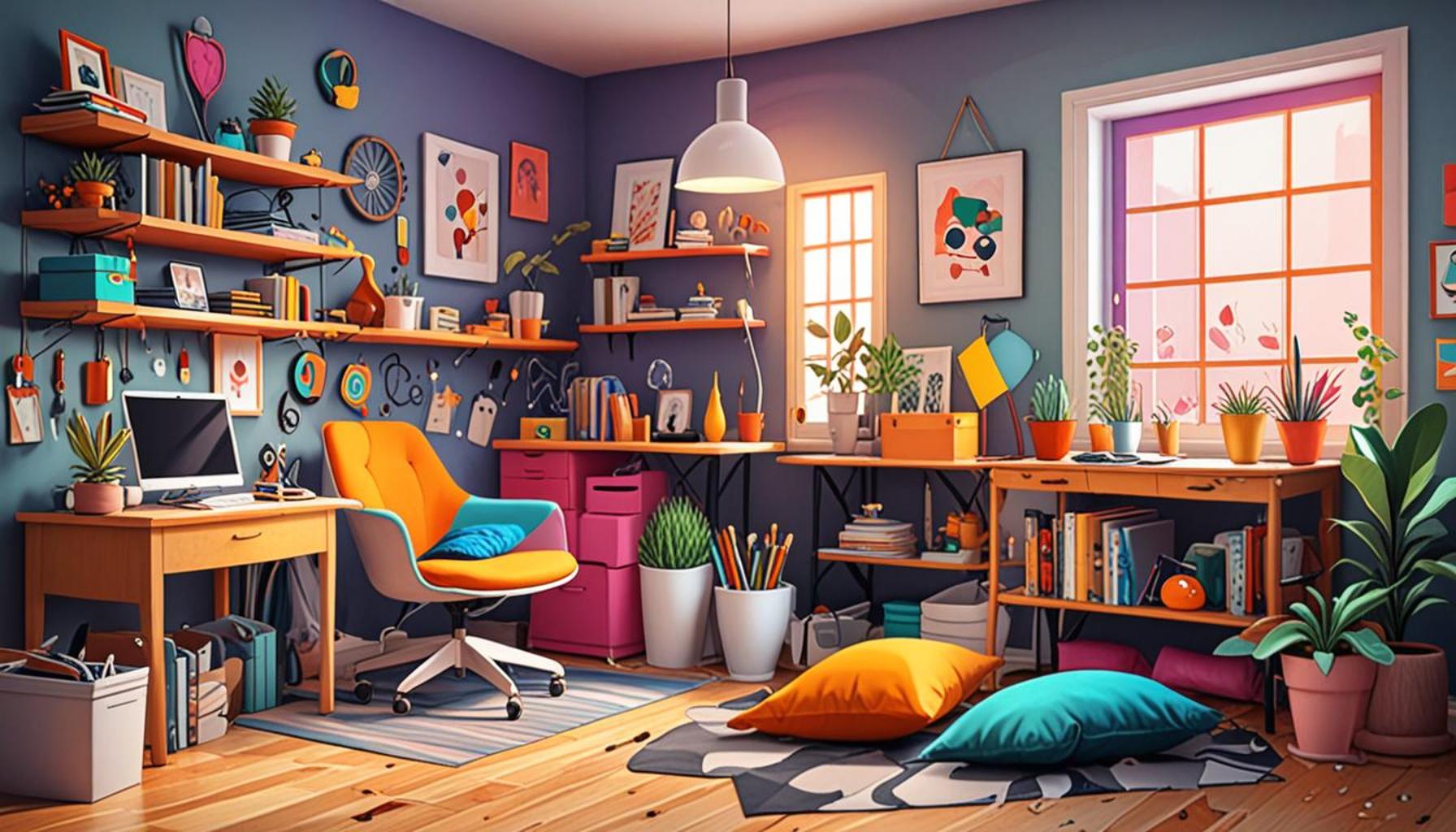
Transforming Clutter into Creativity: How Reducing Objects Can Stimulate Personal Innovation

The Impact of Clutter on Creativity
As we navigate through our daily lives, the incessant barrage of digital notifications, physical items, and social obligations can prove overwhelming. This environment not only invites chaos but significantly impacts our ability to think clearly and creatively. In fact, studies have shown that an influx of visual stimuli can lead to decreased focus and increased stress, ultimately stifling innovation.
Imagine the transformative power that comes from the deliberate act of simplifying your surroundings. By removing physical clutter, you can unlock a myriad of positive outcomes. For instance:
- Enhanced focus: A clutter-free desk can lead to fewer distractions, allowing your mind to hone in on tasks at hand. Researchers from the Princeton University Neuroscience Institute found that physical clutter can make it more challenging for the brain to focus, highlighting the importance of an organized space for mental clarity.
- Increased space: With a clean and well-structured environment, you may find yourself inspired to generate new ideas. Many successful entrepreneurs, such as Steve Jobs and Mark Zuckerberg, are known for their minimalist aesthetics, which reflect their focus on functionality and innovation.
- Improved productivity: Streamlined spaces can facilitate more efficient workflows. A study conducted by the U.S. National Institute of Mental Health found that individuals working in cluttered environments performed tasks 10% slower than those in organized settings, showcasing the tangible benefits of minimalism on productivity.
Moreover, adopting a minimalist lifestyle is not solely about decluttering physical spaces; it encompasses fostering a mindset that prioritizes what is meaningful over what is merely present. Those who embrace minimalism often report surges in creativity, suggesting a direct correlation between clutter reduction and enhanced creative thinking.
Consider this stimulating question: could your next big idea be hidden behind a pile of unused objects? This contemplation serves as an invitation to reassess your surroundings and the significance of each item within your space. Embracing minimalism offers a pathway to clear not just your physical environment but also your mental landscape, illuminating creative pathways previously obscured.
Join us on this insightful journey as we explore how transforming chaos into clarity can unlock your potential for personal growth and inventive thinking. Together, let’s discover the hidden treasures in the simplicity of a minimalist life and how it can propel us to unprecedented heights of creativity.

DIVE DEEPER: Click here to discover more
Embracing Minimalism: A Key to Igniting Innovation
The practice of minimalism is more than just organizing; it is a profound strategy for enhancing creative potential. By intentionally reducing the number of objects that surround us, we empower ourselves to think differently and approach problems with a refreshed mindset. This connection between minimalism and creativity is increasingly evident in personal and professional settings, from artists to tech entrepreneurs, who recognize the value of a simplified workspace.
Psychologists have identified that clutter not only distracts us physically but also mentally. When faced with a disorganized environment, our brains attempt to process numerous stimuli, leading to cognitive overload. This state of overwhelm makes it challenging to generate ideas or solutions. In contrast, a minimalist approach encourages mental clarity, which is essential for personal innovation.
So, how can we effectively embrace minimalism to stimulate creativity in our own lives? Here are several practical steps:
- Assess your possessions: Take a hard look at your belongings and assess their necessity and emotional value. Ask yourself: Do these items serve a purpose? Do they inspire me? Being critical about what remains in your space can drastically change your perspective.
- Focus on utility: Prioritize multifunctional objects that serve dual purposes. This strategy not only reduces the number of items you own but also aligns your environment with your functional needs, paving the way for clearer thinking.
- Create designated spaces: Organize your belongings into specific areas or categories. This method makes it easier to find what you need without sifting through piles, thus minimizing distractions and enhancing focus.
- Introduce creative rituals: Incorporate daily habits that reflect minimalism, such as meditation or journaling. These practices create mental space while fostering innovative thinking.
The benefits of adopting a minimalist mindset are not confined to individual creativity; they extend to collaborative environments as well. Workspaces that embrace minimalism encourage teams to communicate more effectively, fostering a culture of innovation. For instance, tech giants like Google have spaces designed with minimalist principles that avoid sensory overload, thus promoting open dialogue and brainstorming among employees.
Ultimately, by reducing the physical and mental clutter in our lives, we create room for new ideas and inspiration. Each item we choose to keep or discard reflects our values and priorities, forming a curated environment that not only nurtures creativity but also reflects our true selves. This process of transforming clutter into creativity is an ongoing journey—one that invites continuous evaluation and adaptation.
As we delve deeper into this exploration of minimalism and its relationship to creativity, we will uncover specific techniques, inspiring stories, and practical applications that can help you harness the innovative power of a decluttered life.
Understanding the Psychological Impact of Clutter
The concept of decluttering goes beyond mere aesthetics; it dives deep into the realms of psychology and personal growth. Clutter can often represent mental chaos and overwhelm, leading to decreased productivity and heightened stress levels. By intentionally reducing objects in our environment, we effectively create a space that promotes calmness and creativity. Researchers have found that a cleaner workspace can enhance focus and concentration, enabling individuals to channel their energy toward innovative thinking rather than being distracted by surrounding mess.
Creative Freedom Through Minimalism
Minimalism can be considered a catalyst for creativity. When we reduce the number of physical items in our lives, we inadvertently remove the barriers to imagination. Each item we own carries with it a set of memories, responsibilities, and decisions that can weigh us down. By practicing minimalism, not only do we free up physical space, but we also liberate mental bandwidth. This open space allows for new ideas to flourish, as our minds are no longer cluttered with the “noise” of extraneous possessions.
Successful Stories of Decluttering
Many innovators and creatives extol the virtues of a decluttered environment. Famous figures like Steve Jobs and Marie Kondo advocate for reducing possessions to make room for creativity and purpose. For Jobs, the simplicity of his workspace was essential to foster groundbreaking ideas. Similarly, Kondo’s method emphasizes the importance of surrounding oneself only with items that spark joy, allowing individuals to focus on what truly matters. These examples illustrate that transforming clutter into creativity isn’t just a theoretical concept; it’s a practical path to fostering personal and professional innovation.
Practical Steps to Declutter
To embark on this journey of transformation, consider adopting some straightforward yet effective steps. Begin by evaluating the items in your space—determine what is essential and what can be discarded or donated. Implement a “one in, one out” rule to maintain a balanced environment. Additionally, establishing designated spaces for necessary items can streamline organization and reinforce the connection between space and creativity. These practices ensure that your surroundings foster innovation, rather than stifle it.
| Category | Advantages |
|---|---|
| Enhanced Focus | Fewer distractions lead to improved concentration, allowing for deeper thinking. |
| Mental Clarity | A decluttered space promotes a clearer mind, facilitating innovative ideas to emerge. |
As we navigate the labyrinth of modern life, the ability to transform clutter into creativity through simplification and intentional design can unlock boundless possibilities for personal and professional innovation. By acknowledging the profound impact of our surroundings on our thought processes, we can harness the power of decluttering as a vital tool in cultivating a creative and fulfilling life.
DISCOVER: Click here to learn how minimalism can boost your daily efficiency
The Science Behind Decluttering and Creativity
Exploring the relationship between reducing objects and stimulating creativity requires delving into the science of how our environment influences cognitive processes. Research suggests that maintaining a clutter-free space can significantly boost our capacity to innovate. A study published in the journal Environment and Behavior indicates that individuals in organized, minimalist settings demonstrate a greater ability to think divergently—a crucial component of creative thought. This involves synthesizing new ideas and identifying connections that others may overlook.
One critical aspect of this phenomenon is the way in which our brains function in cluttered versus decluttered environments. Neuroscientist Dr. David Strayer from the University of Utah points out that environments rich in extraneous stimuli require more cognitive resources to process information, leading to decreased performance on tasks requiring deep thinking. In contrast, a simplified environment fosters mental clarity, allowing for increased focus and creativity by directing our limited cognitive resources to the task at hand.
One compelling application of this principle can be found in the world of design. Take the example of Apple, which adheres to minimalism in both its product design and corporate ethos. The sleek, uncluttered aesthetics of Apple products are not merely a design choice; they reflect a philosophy that values simplicity. This commitment to minimalism has arguably propelled Apple to be one of the most innovative companies in the world, showcasing how reducing physical and digital clutter can stimulate groundbreaking ideas.
Real-Life Transformations
Many individuals recount transformative experiences after embracing minimalism and decluttering their lives. Consider the story of a successful marketing executive from San Francisco who faced burnout due to excessive workload and distractions. Upon discovering minimalism, she decided to declutter her workspace by removing unnecessary decorations, archives, and even outdated technology that slowed her down. The results were immediate: enhanced creativity, renewed focus, and improved productivity. What’s more, her fresh perspective led her team to initiate a project that redefined their marketing strategies, significantly impacting the company’s growth.
In the realm of education, schools across the United States are increasingly adopting minimalist classroom designs, which emphasize open spaces and reduce visual clutter. Studies indicate that students in minimalistic settings perform better academically and exhibit higher levels of creativity. A prime example can be seen in the Montessori method, which champions a simplified, distraction-free learning environment. Educators recognize how such spaces foster independent exploration and innovative thinking among students.
Techniques to Cultivate a Creative Mindset
Implementing a minimalist lifestyle and workspace encourages innovative thinking, but various practical techniques can enhance this process. One effective method is the 20/20 rule, where individuals evaluate whether an item has brought them joy or utility in the last 20 days. If it hasn’t, it may be time to let it go. This swift and deliberate action promotes a more conscious approach to what we keep around us.
- Visual Cleanliness: Organizing your space by adding elements of visual cleanliness, such as a simple color palette or fewer decorative items, can significantly lessen distractions.
- Digital Declutter: Beyond physical objects, digital distractions can also inhibit creativity. Eliminating unnecessary apps, organizing files, and setting boundaries for screen time supports a clearer mental space.
- Scheduled Downtime: Building time for unstructured creativity into your week can yield unexpected insights. Carve out periods where you disconnect from technology and allow your mind to wander.
As we continue to understand how minimalism enhances creative potential, it is clear that transforming clutter into creativity is not merely about simplifying our surroundings; it is about making conscious choices that elevate our collective knowledge and inspire personal innovation. Each step toward a decluttered life is a step toward unlocking untapped creativity waiting to emerge in our lives.
DIVE DEEPER: Click here to discover the power of simplicity
Embracing Minimalism for Greater Creativity
The journey of transforming clutter into creativity reveals profound insights into the intersection of our environment and our innovative potential. As we’ve explored, a decluttered space not only enhances mental clarity but also allows for greater focus, facilitating the creative processes essential for personal and professional growth. The stories of individuals, from corporate executives to students, demonstrate that simplifying our surroundings can significantly elevate our abilities to think divergently and innovate effectively.
Utilizing techniques such as the 20/20 rule or embracing visual cleanliness creates an environment ripe for exploration and creativity, while minimizing distractions—both digital and physical—enables more profound insights to surface. As demonstrated in the workspaces of modern companies and educational settings, the practice of minimalism transcends mere aesthetics; it enhances our capacity to connect ideas and foster collaborative environments.
Ultimately, the act of reducing objects and distractions should be viewed as a conscious choice, one that opens the door to innovation waiting within each of us. In a world that constantly demands our attention, prioritizing simplicity may well be the key to unlocking our latent creativity. As we confront clutter, whether in our homes or minds, let us embrace minimalism not just as a trend but as a powerful catalyst for personal innovation. The journey towards a clearer, more creative life begins with each mindful decision we make today.